
The days when companies passed over unpaid invoices immediately to external debt collectors are fading.
Spurred on by tighter consumer protection legislation and changes in consumer attitudes, businesses are seeing the benefits of gently reminding their customers of their financial obligations at a much earlier stage in the debt collection cycle.
Of course, there will always be customers who cannot or will not pay, so debt collection agencies (DCAs) still have their place. But, to make the collection process appear less threatening for consumers, companies are starting to value DCAs more as a last resort and less as a first resort.
Not convinced that customers appreciate automation?
According to ING (July 2020) an average of 59% of Europeans who have debt, say they have set up some form of automatic repayment. This is highest for loans from recognized institutions (72%). This presents clear indicators that consumers are much more likely to pay their bills via automated processes.
It seems that customers really do appreciate a kindly and timely payment reminder, especially if it’s delivered through their favourite communication method. After all, who wants a late payment fee or have their insurance coverage discontinued because they forgot to check their bank account balance or mislaid their bill?
The trend is clear: companies are seeking a softer, less aggressive and more timely approach to consumer debt collection. Couple this with the latest technological advances, and it’s easy to see why automated service reminder systems are becoming increasingly popular.
As a matter of fact, maximizing debt collection rates requires the use of sophisticated technology, particularly in the utility sector. Therefore, businesses that do not adopt technology innovations that improve debt collection rates are undoubtedly losing out on a number of advantages.
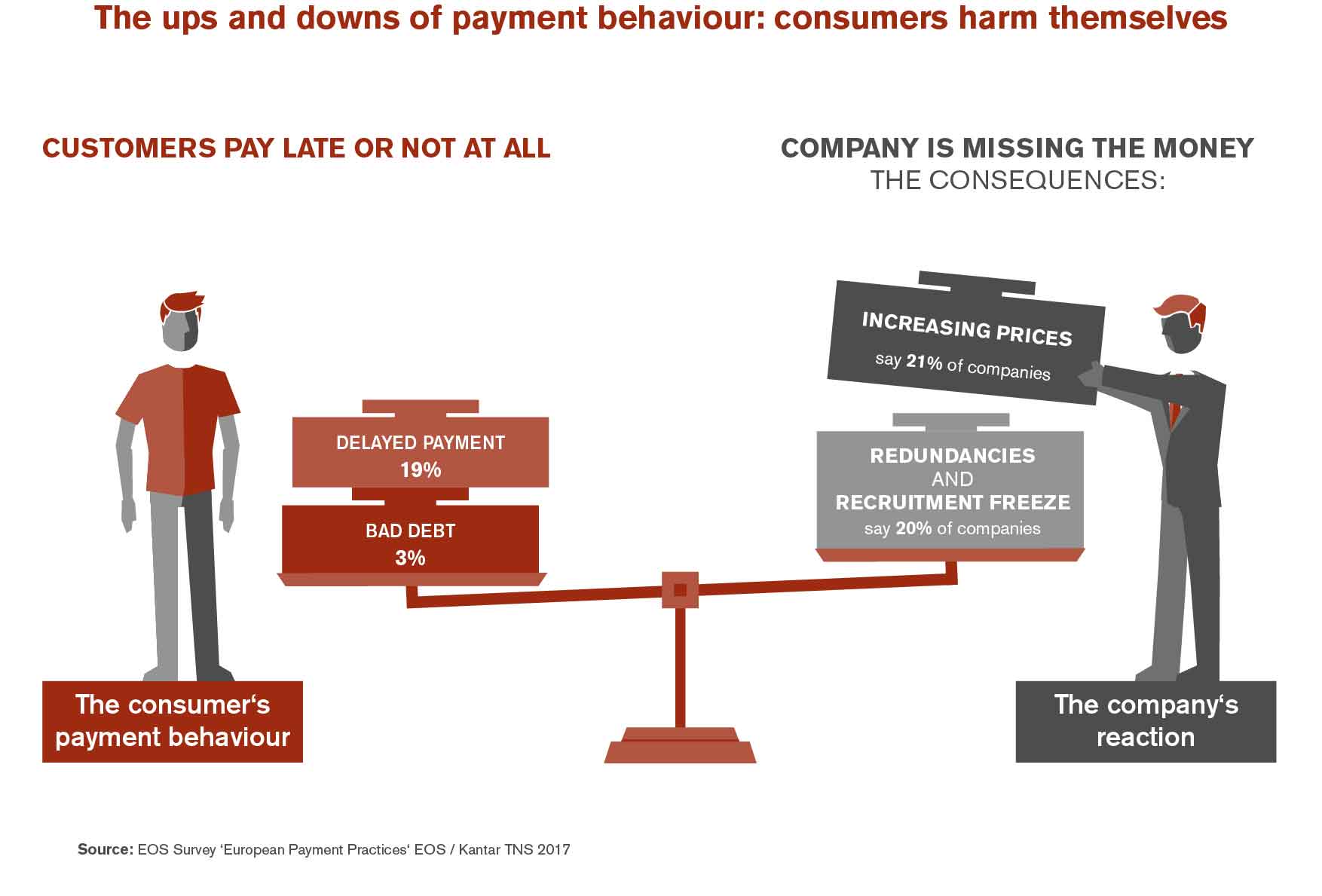
8% of European companies admit having no standardized debt collection processes.
Source: EOS Group, “European Payment Practices 2017”
Sending gentle reminders as soon as an invoice has become overdue is key to customer satisfaction.
In an era of information overload, it’s easy for any of us to overlook the odd invoice or two. Out of all Europeans who paid a bill late in 2019, a third (36%) either forgot or procrastinated.
But well-timed reminders serve another purpose.
By opening a dialogue with customers, they allow companies to identify potential payment problems at an early stage. Encouraging customers to make contact if they have a query about an invoice or problems paying, means a company can take suitable action sooner rather than later. This inevitably reduces the risk of non-payment and avoids court action.
It’s a win-win situation.
Customers feel looked after and reward you with continued business, and companies improve their customer service and reduce their days sales outstanding. This in turn avoids the need to cut personnel or raise prices as a response to outstanding payment receipts.
Developing an effective reminder strategy for your company not only helps simplify your collection methods, but also gets your money in more quickly. Automated service reminder systems play an essential role in this.
By sending your customers a personal message in good time, you maximize your chances of getting paid, and you reduce your collection costs.
The main automated reminder channels are voice, email, text, interactive video and QR codes. Let’s look at those in more detail.
Most automated systems can send thousands of voice reminders in under an hour. A call centre agent, on the other hand, can only make around 25 calls an hour (after dealing with invalid numbers, busy signals, no answers and hang-ups).
The beauty of automated voice reminder systems is that they free up staff to answer incoming calls and handle more complicated issues like invoice queries or payment plans. Since there’s no need to set aside time to make routine reminder calls, staff can concentrate fully on serving customers.
Of course, not all automated voice systems are created equal. Some use computerised voices.
Others, like those used by Alphacomm, employ high-definition human voices.
These natural voice messages are not only more pleasant to listen to (and therefore more likely to be effective) but also flexible enough to match your company’s style and the stage of the collection process. So, you can make a first reminder message sound warm and friendly and a final reminder grave and formal. The choice is yours.
The better automated systems will customise and personalise each message. Mentioning the customer’s name, the amount owed, the nature of the debt and the date it should have been paid prompts the customer to act immediately by either calling back or making that payment.
In a survey of 1,002 U.S. consumers, 33% said late payment fees could have been avoided if companies had contacted them.
Automated email reminders can be dispatched in their thousands almost instantaneously and—in terms of speed and cost—they beat traditional reminder letters hands down.
But the advantages don’t end there. You can schedule email reminders to arrive automatically a certain number of days after the payment date (say, three days after the due date) and at a time your customers are most likely to check their inbox.
This is particularly useful for making sure customers spot your reminder among all the other emails filling up their inbox.
The best times and days to send your emails depends greatly on your target audience. If you determine that your customers are most likely to open their emails after they’ve finished work, for example, you can arrange for delivery to be made at 6.00 pm on a weekday.
This will ensure your email is sitting at or near the top of a bunch of emails to be read when the customer is ready to check incoming mail.
According to Google, 75% of Gmail users use their mobile device to access their accounts.
Source: Backlinko, “63 Key Email Marketing Stats For 2021”
Smart, eh?
Just like voice reminders, emails can be personalized. They can also be designed with your own corporate logo and colours, and be sent from your own domain, so they won’t look as if they’re coming from a third party. This is important from a customer relationship perspective and avoids your email being labelled as spam.
One of the best things about email reminders, however, is that they can include a secure pay link. A pay link lets your customer see their invoice and make the payment in just a couple of clicks, whether they’re on a desktop, tablet or smartphone.
A premium service like ours can even integrate the payment stage with your familiar front-end designs, giving your customers a seamless experience.
And, because the payment amount and reference are pre-filled, errors are reduced, and it’s super easy for both customer and company to check if the payment has been made.
Text messaging (SMS) as a means of communication has been extremely popular in recent years, even among the older generations. It’s no surprise, therefore, that sending payment reminders by text is being adopted by many companies around the world.
Automated text reminders work in a very similar fashion to email reminders. Thousands can be sent out instantaneously, and they can all be personalized.
And—just as with emails—they can include a secure referenced payment link.
Banking apps are readily available on smartphones, which makes paying bills a breeze. And when you consider that more than half the world now uses a smartphone, it’s safe to assume that a large proportion of your customer base are smartphone owners.
Nearly 42% of Americans would prefer companies to contact them via text message.
Source: Nuance Communications, “Collect more, spend less: An ROI guide to collecting through digital channels”
A video reminder is an interactive and personalized video, that uses clear animations and understandable text to remind debtors of an outstanding payment.
Various contact options and solutions are also offered alongside the video. For example, debtors can immediately opt for making a payment arrangement, pay the full amount at once or object to the request.
Video reminders are quite versatile and can be sent via SMS, email, or included in a letter as a scannable QR code.
A major advantage of interactive video is that it’s a great tool for engaging customers with low literacy. For many, opening and reading complicated, threatening letters, is a daunting task. An interactive video animation, on the other hand, is a lot easier to understand.
Quick Response codes are an effective way of guiding customers to a specific landing page. Instead of asking customers to memorize a specific URL and type it in themselves, make it easy for them by printing a unique QR code and including it in a personalized letter.
Upon scanning the code with a smartphone, the customer will be guided to a personalised web page with a clear explanation of the situation and the available payment options. QR codes have been around for over a decade and continue to gain in popularity.
The most resource-intensive part of a dunning strategy is the call centre. What if it were possible to achieve more results, with less?
One innovative way to improve efficiency is to employ AI-powered digital voice assistants as a means to enhance or replace your call centre operations.
Digital assistants are capable of performing customer identification checks, suggesting and processing payment plans, and most importantly: eliminating waiting lines and the possibility of human error. This is because the software can scale up when it is busy, and scale down when it’s not. Your customers never wait in line, and always receive the full attention of the assistant.
The use of digital assistants results in a significant increase in customer satisfaction, the likelihood of payment collection, and greatly reduced overhead costs for call centres and debt collection agencies.
By implementing a digital assistant, your staff is unburdened and better able to tackle the more challenging customer cases.
All of these channels can be used in isolation. But for a truly effective reminder strategy, it’s best to use a mix. Factors that will determine the way you combine the channels include:
For same-day reminders, you may decide that text messaging is the way to go. For bill alerts and slightly overdue accounts, perhaps an email or QR code is more suitable. For significantly overdue accounts, you may consider a voice or video reminder to be more effective.
Advanced automated reminders systems will also allow you to use either of these channels as alternative methods. If, for example, the reminder system can’t leave your customer a voicemail after several attempts, it can follow up automatically with a reminder text or email, according to your customer’s preference.
By using all six channels to send out payment reminders, your customers will find you hard to ignore.
There are a variety of reminder systems out there, so it’s important you understand which features are available and what level of service is provided before you make your choice.
Our best advice is to make a thorough needs analysis before you start shortlisting service providers.
Automated reminder systems at the lower end of the market are most suitable for small businesses because they offer fewer features and a restricted number of data fields.
Customer data is uploaded to the reminder system using a generic file format, which you may well have to configure yourself. What’s more, there’s no ability to personalize the message.
At the upper end of the market are systems designed for medium and large businesses that have a big customer base and send out thousands of invoices. Many of these advanced systems can be fully integrated with your company’s accounts receivable (sales ledger) and collection services, which streamlines your internal processes, shortens your DSO and improves the quality of the customer journey.
Reminders are processed in batches, and thousands can be sent in just an hour. All messages are personalized and variable fields like invoice number, amount and due dates are filled in automatically, based on the data uploaded from your in-house system.
Data is uploaded from your company’s internal accounting system via an encrypted portal or an SFTP connection. This keeps your data secure, but it also means there’s no need to enter or configure data manually.
Other features of premium automated reminder systems can include:
Your needs analysis should identify which of these features would benefit your company.
Our automated voice, email and text reminder systems send out around €100 million payment reminders every month, helping companies improve their cashflow and staff productivity. If you’re ready to reduce payment delays and avoid write-offs, call us today on +31107989 501 to schedule a free consultation.
As all finance directors sagely tell their sales colleagues, “A sale is not a sale until the customer pays up”.
Getting customers to settle their accounts within their credit terms can be easier said than done, however. Some forget, some are drowning in debt, a few don’t pay on purpose.
Yet there’s a growing recognition among companies that sending customers a gentle payment reminder at an early stage and in the communication channel they prefer reaps many benefits.
Customers get a chance to resolve the situation before the next stage in the debt collection process is reached. Most simply pay up immediately. A smaller but significant percentage call customer service or start a live chat session to dispute the invoice or arrange a payment plan. Either way, the reminder encourages action.
Companies, meanwhile, avoid the expense of issue resolution and drive up their DSO. In addition, they’re doing wonders for customer retention and brand reputation.
If you found this article informative, please share it with your colleagues. If you’d like to chat to one of our experts about your payment fraud concerns, please give us a call on +31646228288.
Alphacomm is a global partner in all top up, reminder, dunning and payment challenges. Collectmaxx, our payment reminders solution, helps companies get paid faster, at lower costs, by utilizing modern communication channels, like interactive video, as well as the customer’s preferred payment methods. If you’re ready to give your customers the ultimate top-up convenience and boost brand loyalty, schedule a free consultation today.