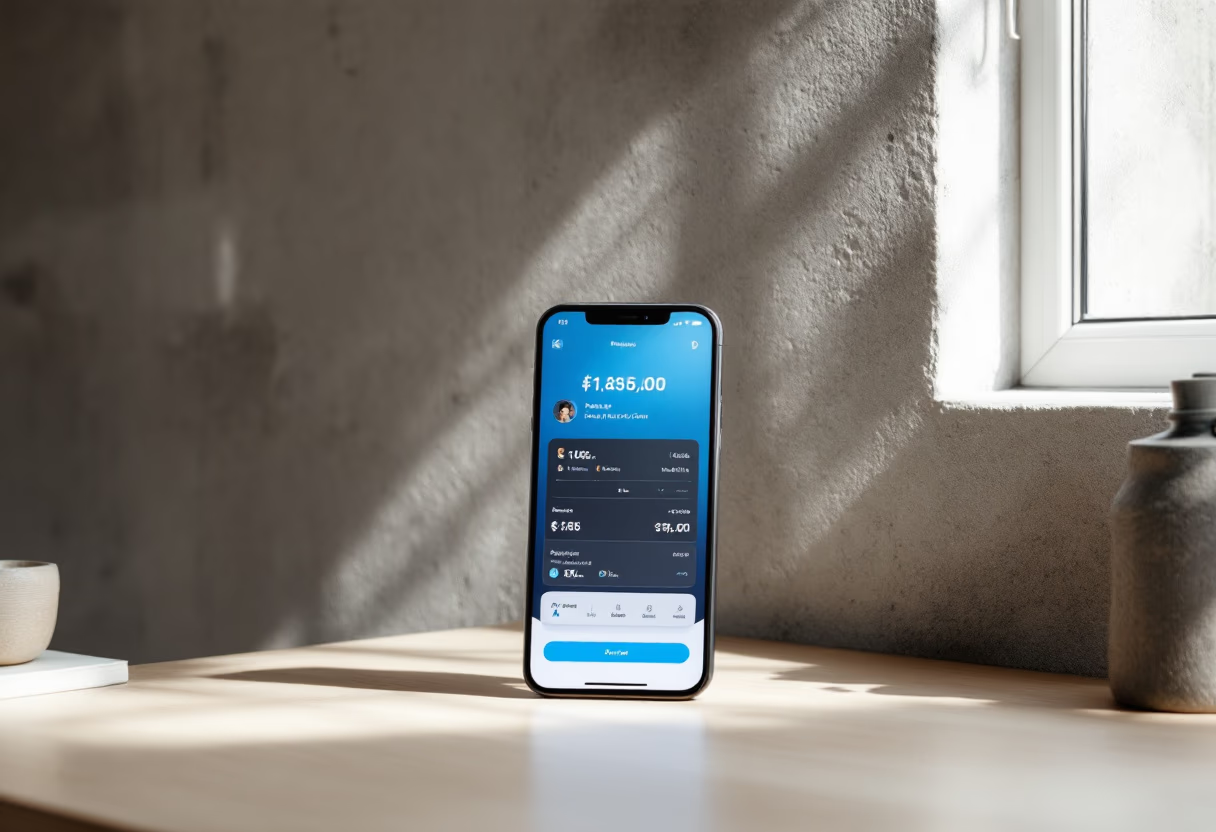
Offene Forderungen, verspätete Zahlungen und manuelle Mahnprozesse belasten die Liquidität vieler Unternehmen. Wenn Teams Rechnungen, Konten, Fristen und Zahlungserinnerungen über E-Mails, Listen und einzelne Anrufe verwalten, entstehen schnell Engpässe. Die Anzahl der Fälle steigt, der Überblick geht verloren und wertvolle Ressourcen werden für wiederkehrende Aufgaben gebunden.
Collectmaxx bietet Inkasso Software für digitale Zahlungserinnerungen und kundenfreundliches Mahnwesen. Die Lösung hilft Unternehmen, Kommunikation zu automatisieren, Zahlungseingänge zu beschleunigen und den manuellen Aufwand im Forderungsmanagement zu reduzieren.
Statt auf rein manuelle Prozesse zu warten, können Teams mit Collectmaxx strukturierte Workflows nutzen: E-Mails, SMS, AI/HD Voice, interaktive Videos und QR-Code-Zahlungslinks führen Kunden und Schuldnern verständlich zur nächsten Handlung. So wird Inkasso effizienter, transparenter und professioneller.

Payment collection automation refers to the use of software and automated workflows to manage the accounts receivable process more efficiently.
Rather than manually monitoring outstanding invoices, sending payment reminders, updating payment status, or matching customer payments, automation software performs many of these tasks according to predefined rules.
Modern payment collection software can support activities such as:
By reducing manual processes, businesses can improve operational efficiency while allowing finance teams to focus on higher value activities.
Although every platform offers different capabilities, most payment automation systems follow a similar workflow.
After an invoice is created within the accounting system or invoicing platform, the automated system monitors the payment cycle based on the agreed payment terms.
As the due date approaches, automated payment reminders can be scheduled to encourage timely customer payments.
If payment has not been received after the due date, additional reminder sequences can be sent according to the business's collection policies.
Once payment is completed, the system updates payment status and supports payment tracking while reducing the need for manual data entry.
Some solutions also assist with automated reconciliation by matching payments to outstanding invoices, helping maintain accurate financial records.
Customer expectations continue to evolve alongside digital payment technologies.
Businesses are expected to provide convenient payment methods, clear communication, and efficient service throughout the payment process.
At the same time, finance leaders are under increasing pressure to improve cash flow management while reducing operational costs.
Payment automation helps address both objectives by simplifying routine collections activities without compromising the customer experience.
Instead of spending hours on repetitive administrative work, finance teams can focus on strategic financial management, customer support, and resolving more complex payment situations.
One of the most significant payment collection automation benefits is improved cash flow management.
Consistent communication throughout the payment cycle encourages customers to review invoices and complete payments according to agreed payment terms.
Automated payment reminders help keep invoices visible before they become significantly overdue, reducing the likelihood that payments are overlooked.
As customer payments become more predictable, businesses gain better visibility into incoming cash receipts and overall financial performance.
Improved cash flow also supports healthier working capital, making it easier for organizations to manage day-to-day operations and plan for future growth.
Manual data entry is often one of the most time consuming parts of accounts receivable management.
Finance teams may spend considerable time entering payment information, updating invoice records, checking payment status, and reconciling customer accounts.
Automation reduces much of this repetitive work by transferring information between connected systems and updating records automatically.
Eliminating manual data entry not only saves time but also reduces the likelihood of human error that can occur when information is entered repeatedly across multiple platforms.
Sending payment reminders manually becomes increasingly difficult as invoice volumes grow.
An automated payment reminder system helps businesses maintain consistent communication without requiring staff to remember every due date.
Businesses can create reminder schedules based on their payment terms, allowing reminders to be sent before an invoice is due, on the due date, and after a payment becomes overdue.
Each reminder can include useful information such as the invoice number, payment amount, payment instructions, payment link, and contact details for customer support.
Providing complete and timely information makes it easier for customers to complete payments without unnecessary delays.
Accounts receivable management involves much more than collecting payments.
It also includes monitoring outstanding invoices, tracking payment status, managing customer communication, and maintaining accurate financial records.
Payment collection automation brings these activities together within a more structured workflow.
Instead of relying on spreadsheets or manual tracking, finance teams gain greater visibility into receivable management while reducing administrative complexity.
This allows businesses to identify overdue payments more quickly and take appropriate action before invoice balances continue to age.
Manual processes naturally increase the possibility of mistakes.
Incorrect invoice numbers, duplicate data entry, missed payment reminders, or outdated payment status records can create confusion for both customers and finance teams.
Automated systems help standardize routine tasks by following predefined workflows and applying information consistently across the payment process.
Reducing human error improves data accuracy while supporting smoother financial operations.
Customers appreciate payment processes that are simple, transparent, and convenient.
Automated payment reminders help customers stay informed about upcoming due dates while providing easy access to payment methods and payment links.
Rather than searching for invoice details or contacting customer support, customers receive the information they need to complete payment efficiently.
This creates a smoother customer experience while supporting stronger customer relationships over time.
Businesses increasingly offer customers a variety of payment methods to improve convenience.
Depending on the payment collection software, customers may be able to complete electronic payments using options that best suit their preferences.
Offering flexible payment methods helps reduce barriers during the payment process and makes it easier for customers to pay invoices on time.
This flexibility also supports businesses serving customers across different markets and payment preferences.
Keeping track of customer payments manually can become challenging as transaction volumes increase.
Payment tracking tools provide finance teams with better visibility into payment status throughout the collection process.
Instead of manually checking each outstanding invoice, businesses can quickly identify which invoices have been paid, which remain overdue, and which may require additional follow up.
This improved visibility supports faster decision making while reducing the time spent reviewing individual customer accounts.
Payment collection automation connects multiple activities into one coordinated process.
Invoice processing, payment reminders, payment tracking, customer communication, and reconciliation can all become part of a single automated workflow.
Rather than managing each activity independently, businesses create a more efficient payment process that reduces delays and supports operational efficiency.
This integrated approach allows finance teams to spend less time managing repetitive administrative tasks and more time supporting business growth.
Matching customer payments to the correct invoices can be one of the more time-consuming tasks in accounts receivable management.
Without automation, finance teams may need to review payment references, compare bank transactions, and manually update accounting records.
Payment collection automation helps simplify automated reconciliation by matching payments with outstanding invoices and updating payment status more efficiently.
This reduces repetitive work while helping maintain accurate financial records.
Reliable cash forecasting depends on having clear visibility into expected customer payments.
When businesses can easily monitor outstanding invoices, payment status, and payment trends, they are better positioned to plan future financial activities.
Payment collection automation provides finance teams with more timely information, making it easier to understand receivables and support better cash flow management.
Improved visibility also helps businesses make informed decisions about budgeting, investments, and day-to-day operations.
As organizations grow, the number of invoices, customers, and payment transactions often increases.
Processes that work well for a small customer base may become difficult to manage through manual intervention alone.
Automated payment systems help businesses scale their collections process without relying entirely on additional administrative resources.
Whether managing hundreds or thousands of invoices, automation provides a more consistent approach to payment collection while supporting continued business growth.
Many businesses already rely on accounting software to manage invoicing, financial reporting, and accounts receivable.
Payment collection automation works most effectively when it fits naturally into these existing systems.
By integrating with accounting platforms, businesses can create a seamless data flow between invoicing, payment tracking, customer records, and financial reporting.
This reduces duplicate data entry while helping maintain accurate and up-to-date information across multiple systems.
Payment gateways play an important role in helping customers complete payments securely and conveniently.
Many payment collection platforms support connections with payment gateways, allowing customers to pay directly from payment reminders or online invoices.
Providing convenient payment options reduces unnecessary steps in the payment process and encourages customers to complete payments more quickly.
A simpler payment experience benefits both customers and finance teams.
Outstanding invoices require consistent attention to prevent payment delays from affecting the business's cash flow.
Automation helps businesses organize overdue invoices based on payment status, invoice age, or internal collection policies.
Instead of manually reviewing every customer account, finance teams can quickly identify accounts that require additional attention.
This supports a more proactive approach to accounts receivable management while reducing unnecessary manual processes.
Administrative tasks such as sending payment reminders, updating customer records, processing invoice information, and tracking payments can consume significant staff time.
By automating repetitive tasks, businesses reduce the amount of manual work required throughout the payment process.
This allows finance teams to focus on higher-value responsibilities such as customer communication, dispute resolution, and financial planning.
Reducing repetitive work also contributes to greater operational efficiency across the organization.
Successful payment collection depends on maintaining positive customer relationships.
Automated payment reminders help businesses communicate consistently while providing customers with clear payment instructions and timely updates.
At the same time, finance teams remain available to handle more complex conversations when personal communication is needed.
This balance between automation and human support creates a professional payment experience that encourages trust and long-term customer satisfaction.
Not every invoice follows a standard payment journey.
Some customers may question invoice details, request clarification, or raise concerns before making payment.
While automation can continue monitoring payment status and reminder schedules, disputed invoices often benefit from direct communication with finance teams.
Combining automated workflows with manual support helps businesses resolve issues while maintaining accurate payment records.
Businesses operating across different countries often manage customer payments in multiple currencies.
Payment collection automation can support these international payment processes by creating consistent payment workflows regardless of customer location.
When integrated with suitable payment solutions, businesses can manage cross border payments more efficiently while maintaining accurate payment tracking and customer communication.
This simplifies receivable management for organizations serving a global customer base.

Manuelle Prozesse im Forderungsmanagement sind zeitintensiv und fehleranfällig. Agenten müssen offene Forderungen prüfen, Mahnung für Mahnung vorbereiten, Zahlungseingänge kontrollieren, Fristen überwachen und die Kommunikation dokumentieren.
Mit steigender Anzahl offener Fälle wächst der Aufwand erheblich. Fehlende Transparenz über Forderungen erschwert das Forderungsmanagement zusätzlich. CFOs, Teamleiter und Sachbearbeiter brauchen aktuelle Daten, um Risiken, Engpässe und Prioritäten richtig einzuschätzen.
Inkasso Software schafft eine strukturierte Basis. Automatisierung spart Zeit, reduziert manuelle Aufgaben und schafft mehr Kontrolle über Mahnverfahren, Kommunikation und Zahlungseingänge.

Rechnungen zu informieren. Zahlungserinnerungen können regelbasiert ausgelöst werden, zum Beispiel vor Fälligkeit, nach Ablauf einer Frist oder bei ausbleibender Reaktion.
Collectmaxx unterstützt solche Workflows mit digitalen Kanälen und klarer Nachverfolgung. Teams können Mahnstrategien definieren, Zielgruppen segmentieren und Prozesse standardisieren, ohne jede Interaktion manuell auslösen zu müssen.
Regelbasierte Automatisierung der Zahlungserinnerungen erhöht die Effizienz und reduziert das Risiko, dass offene Konten übersehen werden. In vielen Projekten können automatisierte Mahnprozesse Zahlungsverzüge deutlich reduzieren; konkrete Ergebnisse hängen jedoch von Branche, Datenqualität, Kommunikationskanälen und Ausgangssituation ab.

Bei der Auswahl einer Inkasso Software sollten Unternehmen nicht nur auf eine lange Funktionsliste achten. Entscheidend ist, ob die Software zu den eigenen Prozessen, Anforderungen und Teams passt.
Wichtige Kriterien sind Automatisierung, Flexibilität, Sicherheit, Integrationsfähigkeit, Benutzerfreundlichkeit, Transparenz und die Fähigkeit, Kundenkommunikation professionell zu gestalten.
Auch Migration und Einführung sollten berücksichtigt werden. Eine gute Lösung sollte vorhandene Daten, Prozesse und Systeme respektieren, statt unnötige Komplexität zu schaffen.
Von Branchenführern geschätzt
Entdecken Sie, wie Unternehmen ihren Cashflow beschleunigen und die DSO mit automatisierter, KI-gestützter Zahlungsrückgewinnung reduzieren.
Überfällige Rechnungen sanken in einem Quartal um 40 %. Automatisierte Sprachansprache machte das Inkasso mühelos.

KI-Automatisierung reduzierte manuelle Aufgaben und verbesserte die Kundenzufriedenheit in unserem gesamten Portfolio.

Verspätete Zahlungen werden schneller und mit weniger Reibung für Kunden und Mitarbeiter abgewickelt.

Automatisierte Erinnerungen und Zahlungslinks optimierten den Forderungseinzug und steigerten den Cashflow.

Nahtlose Integration und Echtzeit-Dashboards geben uns die volle Kontrolle über unsere Forderungen.

Strukturierte, respektvolle Kommunikation macht die Zahlungseintreibung intelligenter und effektiver.

Haben Sie weitere Fragen? Unsere Experten helfen Ihnen gerne weiter.
Automatisierte Kontaktaufnahme für jede überfällige Rechnung.
KI-gesteuerte Anrufe, SMS und E-Mail-Workflows.
Live-Dashboards. Mühelose Integration.